More than the scheme has changed under Kane Wommack’s 4-2-5 system
Welcome back to the Thin Red Line Knowledge Base series: getting you caught up on the systems Alabama runs under Coach DeBoer, what’s changed from the Saban years, philosophical differences — even adding entire new positions, as we see most notably on the defensive side of the ball.
The last time we gathered ’round the Crimson flames, we began with a brief overview of Kane Wommack’s 4-2-5 system. We won’t fully recap that here, but TL/DR:
If the 3–4 leans on the versatility of four specialty linebackers, and the 4–3 leans on four beefy defenders to control the line of scrimmage, you can probably already guess what the 4–2–5 is aiming at: it’s a greedy scheme.
The 4–2–5 seeks to control the run with the down four defenders, while having a pair of linebackers, but also employing a fifth defensive back to stop passing attacks.
And, while the 4–2–5 is already known for its aggression, the Wommacks take that to the Nth degree, even if it allows a maddening number of first downs between the 30s, especially on chunk plays and miscommunications.
And, the strengthof the 4–2–5 is also its weakness: its aggression at the expense of forcing mistakes. The 4–2–5 may give up big plays every now and again, but it is still a very hard defense to play a clean game against, as it emphasizes havoc, contesting passes, a flurry of pre-snap looks and post-snap assignments. And it is done in service of one main goal: forcing mistakes. No surprise then that under Wommack, Alabama has been in the Top 10 in takeaways.
The philosophy may be a bit different, in that the aggression is coming from the defensive backfield and in creating chaos and confusion over mechanical execution. But, you’ve seen some of these defensive looks before — Alabama played quite a lot of 4-2-5 under Golding and Lupoi. In fact, when Golding was hired, I speculated that he was brought in specifically to add the 4-2-5 and 3-3-5 stack to Nick’s system:
That turned out to be prophetic:
Finally, for you Xs and Os nerds curious about ways to stop the spread, one that is arising more frequently is the 3-3-5 stack and the 4-2-5. The Stack was popularized by Joe Lee Dunn (among others), but it has never really gone away. TCU’s Gary Patterson is famously a 3-3-5 guy. Alabama showed a lot of stack looks last season, as well.
And, now that I think about it, you know who else came from the 3-3-5 and 4-2-5 tradition? Ummm…Pete Golding. I remember writing about it four years ago.
Maybe this has been Saban’s plan with Golding all along, and the Tide has been recruiting to get to this point — with 2021 being the unveiling of the new-look Alabama defense? Can it be incorporated seamlessly into the Cover 7 and Pattern Match C3 schemes that Saban already invented?
We know ball.
But a dedicated system that adds an entirely new defensive back, while eliminating a linebacker requires more than slapping a different label on the same ole’ athletes; it requires entirely new positions, and new types of athletes. It requires DBs that are physical against the run, that can overpower wideout assignments, and that can drop into linebacker coverage roles or fill gaps as the need arise.
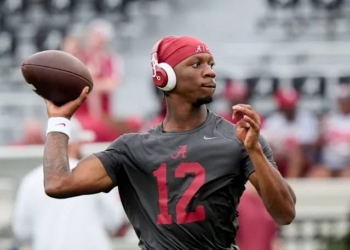
Take a look at these hosses:
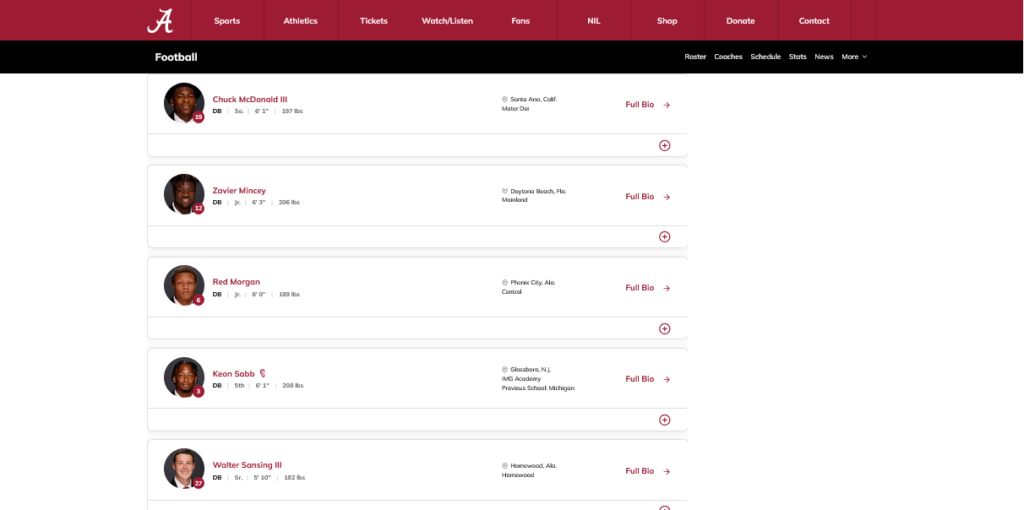
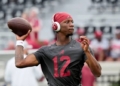
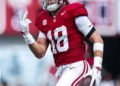
Five years ago, Alabama had three DBs over 6’1″. In 2026, there are eight on the roster, and half of them are at least 6’3″
So, what are these new positions? And how have existing ones changed? Well, we are not ones to reinvent the wheel — there’s good damn work out there; borrow it and credit the outstanding TL/DR here by Ann Snyder at the Tuscaloosa News:
The bandit position
The bandit spot is basically a defensive end but is more of a hybrid defensive lineman/edge rusher. Under Wommack’s system, the bandit will line up on the edge of the defensive line and can either rush the quarterback or drop back into coverage.
Candidates to fill this role for the Crimson Tide are Jah-Marien Latham and Texas A&M transfer LT Overton. Latham, a reshirt senior, is currently the presumed starter at the bandit position for the Crimson Tide. He described the position as doing the same thing he did last year as a defensive end under Saban, but with more freedom.
“I still do the same thing, I still play the same position, but it’s like now I have more freedom,” Latham said during spring practice. “I have more freedom to showcase that I got speed off the edge, I got power off the edge, I can win inside, I can drop into coverage. It’s just allowing me to show everything that I have in the bag.”
The wolf position
The wolf position is a hybrid edge rusher/outside linebacker with an ability to drop back into coverage while still being expected to be one of a team’s primary pass rushers. The wolf will typically line up opposite of the bandit along the defensive line with down linemen in between the two, but has a smaller body type than the bandit position and is a lot quicker.
Candidates to play the wolf for the Crimson Tide this season include Que Robinson, Keanu Koht and Qua Russaw, amongst others. Robinson , a redshirt senior, is the projected starter for Alabama in this role, and has been showing signs of leadership through Alabama’s first week of fall camp.
“Like I said, it’s all about the ball,” Robinson said after Alabama’s second day of fall camp. “Trying to get takeaways, trying to show everybody what we can do this season.”
And that aggression is given free reign:
There is a reason that the defensive line especially loves the new scheme; it’s about pinning ears back, not gap discipline:
The rest do not change much in their look, though they do in both naming convention and particularly in how the assignments create their own set of weaknesses that are simply baked-into the system and type of athlete recruited now.
Tag-teaming The Athletic and Brent, over at Roll ‘Bama Roll:
Sting — The weakside linebacker, which will be Jihaad Campbell. The Mike (middle) linebacker, Deontae Lawson, has the same name under Wommack.
Wolf — The strongside linebacker/edge defender that Alabama fans know as Sam, which was Dallas Turner’s role last season.
Husky — The Star position, which was manned by Malachi Moore last season.
Rover — The strong safety or Jaylen Key’s position last year. There are times when the strong or free safety is a single-high safety, but the Rover mostly plays closer to the formation and has more man coverage responsibilities.
In name, the defense is a 4-2-5. In practice, though, the defensive line typically lines up more as a a traditional 3-4 under front, with the two defensive tackles tilted to the weak side (one lined up between the guard and center on the strong side and the other between guard and tackle on the weak side), with the Bandit playing on the edge on the weakside while the Wolf acts as the stand up edge rusher against the TE/T with the Sting ready to back him up.
Often, they’ll line up in more of a pure 3-man even front with the Wolf playing as a wildcard, lining up just behind the line of scrimmage. If the offense puts the TE on that side, they will shift him down to the more 3-4 under look with the other three linemen making a late shift away… but if there is no TE, he may rush the edge or will sometimes freelance and move to hit lanes between the linemen, rather than just from the edge. This is often done just pre-snap, so it’s not really a true “stunt”, but more of a late sh ift into a B-gap blitz. The Wolf is more than an edge rusher, and has to be adept at many styles of blitzing – think Clay Matthews with the Green Bay Packers for a high-profile example.
And, yes, this comes with weaknesses…which you’ve seen on too many Saturday afternoons.
Where this differs from a traditional 3-4, though, is the Bandit position. Rather than being a 290-pound defensive tackle, the Bandit is generally built more like a big end in a traditional 4-3 — somewhere in the 265-280 range. While he’s an edge rusher that often rushes from a standup position, he’s intended to be strong enough to handle an edge in the run game on his own, but usually won’t be dealing with any double teams, since they try to keep him on the weakside.
Now, you might be thinking, “doesn’t this overall setup feel a little light?” Only two true down linemen, and often leaving two linebackers to handle a tackle and TE on one side while leaving a DE hybrid on his own on the other?
Well, that’s where the Rover and Husky come in. In theory, the Rover is essentially a traditional strong safety and the Husky is a slot corner, or Star in Saban terminology.
However, in Saban’s defense, the free safety and strong safety were pretty much interchangeable spots, while the Star was it’s own beast – a corner playing as a linebacker. In Wommack’s defense, though, the Rover and Husky are much more similar, while the free safety is a true centerfield deep safety. While some play calls will have two safety shells, they’ll rarely start a play looking that way. Wommack much prefers a single-high safety while the Rover and Husky both play closer the line of scrimmage. They are a tandem of screen-stopping, RPO-blasting defensive backs who are custom-built for defending the two mesh points that most of college football has gravitated towards attacking as a basis of the offense since 2013.
The downside of this, though, is that the two outside corners and the free safety are now tasked with defending the entirety of the sidelines and deep center of the field on their own. Cover 3 is the staple zone scheme here, and the outside corners need to have exceptional long speed and ball tracking to be able to cover the sideline go-balls with no overhead help. and the free safety has a monumental task of making tough decisions on who to pick up with deep over route combos.
As with every sport predicated upon creating schematic mismatches, there are trade-offs that you have to decide whether you can live with — and for a lot of ‘Bama fans, it is dismaying that the price the Tide pays for having a no-fly zone and forcing turnovers is a defensive front that light in the ass against power rushing attack and that can put some pressure on quarterbacks, but will never ring up sacks like those monsters of Tide teams past.
For more on positional play, check out that first Knowledge Base article, as well as the links we’ve provided to you in these two pieces to date.
Up next, we’ll probably start taking a look at the offense, easily the more controversial of DeBoer’s new systems.