
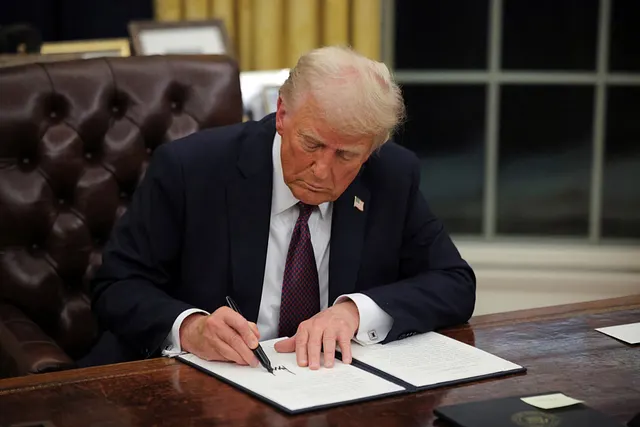
The order directs the NCAA to create rules that mandate college athletes can play for “no more than a five-year period” and allows them to transfer schools only once before they graduate without having to sit out a season.
The order also states that the NCAA should update its rules to create a national registry for player agents and create policies that prevent schools from cutting scholarships or other opportunities for women’s and Olympic sports in order to pay their athletes.
“College sports cannot function without clear, agreed-upon rules concerning pay-for-play and player eligibility that can’t be endlessly challenged in court, as is the case now,” the White House said in a news release about the order.
The rule changes are scheduled to go into effect Aug. 1. A school that plays an athlete who doesn’t meet these new limits could risk losing its federal funding.
There are some good things in here, of course — prohibiting schools from cutting olympic/TIX sports to fund the big boys, mandates for continuing health care, thumbscrews for shady agents and hangers-on etc.
No one is quibbling with that. Indeed, much of the EO is already within the SCORE Act, proposed NCAA actions, or alternate legislation.
So, in terms of polemic, of satisfying populism, it’s good theatre, at least.
But in terms of the law, it’s patently unconstitutional and is not only dead on arrival, it’s dead before even being thrown in the ambulance.
Many of the claimed powers here are beyond the scope of government to monitor, much less regulate. And even what actions lie within a clear federal purview, are properly powers belonging to Congress under their ability to regulate interstate commerce.
It’s also not at all clear, after President Trump gutted the Department of Education and has threaten to shutter the entire administration, who would even be responsible for enforcement of his prerogatives or how.
One presumes that it would fall to the Department of Justice, but there is a separation of powers problem there too, since what delegation of power Congress ever gave the executive branch was to a Department of Education. It was never vested to the lawyers. Plus, judges have repeatedly and unanimously struck down administration attempts to withhold congressionally allocated funds based on their political whims (impressively, he even appointed four of them).
This will be no different.
Outside of its legal problems, and beyond the irritation and expense about to be incurred by universities, NCAA President Charlie Baker does see at least see a silver lining in the EO: it can be a spur Congressional action.
“We need congressional action to sort of seal the deal on a number of these things, which is good because we do, and getting a bipartisan agreement on a number of those issues would be a really big thing,” Baker said. “Based on my own conversations with a lot of Democrats and Republicans in Washington over the course of the past month or two, I do think there’s a lot of common ground there.”
“On some of these issues, it’s hard for us to do this without at least some support from the feds. The courts are one way to settle the debate, but it takes a really long time, and it creates a lot of uncertainty.”
I would like this to be as true as Charlie does.
But the ideological divide in what separates Senators Cantwell and Cruz is beyond resolution in an election year, where the House is certain to flip to the Democratic Party, and Republicans are actually in unexpected danger of the unthinkable: losing the Senate.
Against that backdrop, Ted Cruz is not going to suddenly approve hundreds of thousands of new potential union-eligible state employees in an election year; nor is Maria Cantwell going to leave them to the tender mercies of the independent contractor framework or leave former players without health care.
And then there is the simple matter of the Byzantine congressional procedure the SCORE act has to undergo. It died in committee just a few weeks ago. Even if it could be revived, it resets the legislative calendar, with an entirely new system of votes and testimony, etc. Then it goes to a full committee, where all of that is true. Then it would go to the full Senate, where all of that would be true, plus floor debate and Amendments.
And that’s just the Senate. The House has to do something similar, and then also either pass this exact same piece of legislation, or one that is nearly identical in scope such that it can be reconciled and sent to the President for signing.
But look around, man. We can’t even keep fucking airports open or border patrol funded. And now we’re supposed to believe that both parties are going to play nice about unions six months before an election? I was born at night, but not last night.
Nothing is going to happen, in other words. At least not in 2026.
It’s good theatre by President Trump. It’s probably even good politics. But it’s bad law. Worse, it’s an inexcusable waste of federal resources and tax dollars. And even under its secondary purpose, as a goad or a prod, it is unlikely to have any impact.
They say that if you can fake sincerity you have it made. Unfortunately, that’s how our federal government operates: they rubberstamp a memo written by a junior staffer, or pass a non-binding resolution, and everyone acts as though they’ve done any sort of heavy lifting.
And what makes this EO particularly laughable is that here we are dealing with the two most broken institutions in America combining their powers like a Voltron of Incompetence: the federal government and the NCAA.


But at least Voltron was cool.